
Air Conditioning
AC Short Cycling? Why It Keeps Turning On and Off
AC turning on and off every few minutes? Learn what normal cycling looks like, run the safe homeowner checks in order, and know when short cycling needs a technician.
The short answer
An air conditioner that starts, runs a few minutes, shuts off, and repeats — “short cycling” — is protecting itself or responding to a control problem. First confirm what you’re seeing is actually abnormal: on a hot day, frequent cycling near setpoint can be normal. If the cycles are clearly too short and the house never settles, check the filter, thermostat settings and placement, open vents, and outdoor clearance. Anything involving capacitors, refrigerant pressure switches, wiring, or system sizing belongs to a technician.
- Symptom
- AC starts and stops every few minutes without completing a full cooling cycle
- Likely cause
- Thermostat issue, clogged filter, blocked vents, frozen coil, or — for a pro to determine — refrigerant, electrical, or sizing problems
- Safe check
- Filter, thermostat mode and schedule, open vents, outdoor clearance, visible ice, tripped breaker observed once
- Next step
- Call a technician if cycling persists after the safe checks, or if you find ice, trips, smells, or noises
What “short cycling” actually means
A healthy central AC runs in sustained cycles — typically on the order of a quarter hour or more per cycle on a warm day — then rests. Short cycling means cycles far shorter than that, repeating all day without the house reaching setpoint.
Two patterns people confuse with it:
- Won’t start at all — nothing runs. That’s a different problem with a different checklist: our won’t-turn-on guide.
- Runs constantly but never cools — the opposite pattern. See our no-cooling walkthrough.
If your system runs steadily but the air is warm, or nothing runs at all, you’re in the wrong guide — the links above take you to the right one.
Safe homeowner checks, in order
Work through these before calling anyone. Stop at the first step that resolves it.
1. Thermostat: mode, schedule, and placement
- Mode on Cool with a setpoint clearly below room temperature.
- Check for schedules, holds, or away-modes fighting you — a program that keeps changing the setpoint looks exactly like short cycling.
- Replace weak batteries.
- Notice where the thermostat lives: direct sun, a nearby lamp or TV, or a drafty hallway makes it read wrong and cycle the system erratically. You can’t relocate it as a quick fix, but a bad location explains otherwise mysterious cycling — and relocating it is a technician’s job, not a DIY one.
2. Air filter and vents
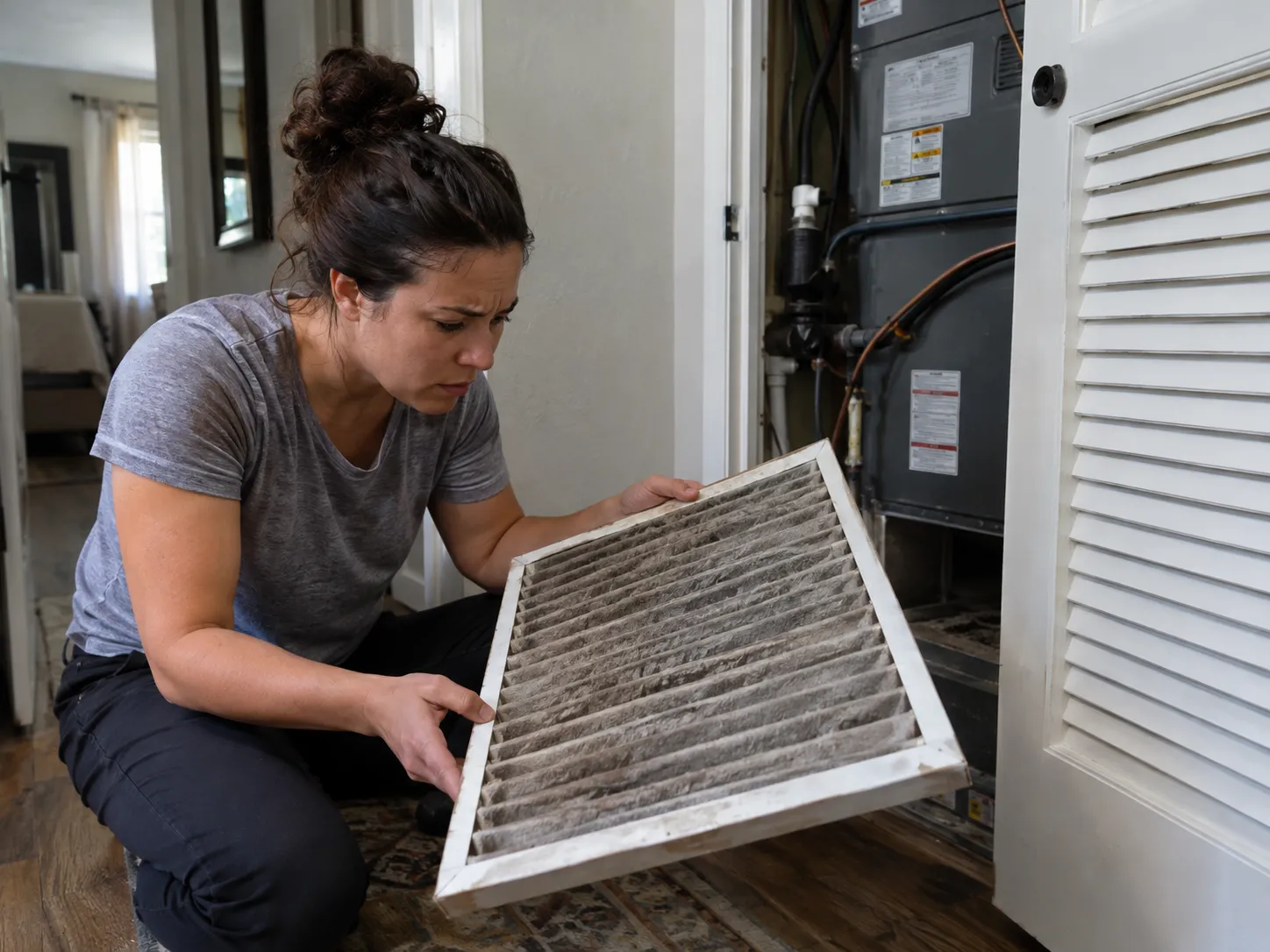
- Replace a dirty filter — restricted airflow is the most common homeowner-fixable cycling trigger, and it also protects against the frozen coil described in our frozen-coil guide.
- Open all supply vents and clear blocked returns. Closing vents in unused rooms does not help and can unbalance the system into cycling.
3. Outdoor unit and visible ice
- Clear debris and vegetation around the condenser so it can breathe.
- Look for frost on refrigerant lines. If you find ice, stop this checklist and switch to the frozen-coil thaw procedure — ice changes the diagnosis.
- Note any new buzzing or humming on startup, but don’t investigate inside the unit. Report it to the technician instead.
4. Breaker — observe once
- If a breaker has tripped, reset it exactly once after the system has sat off a few minutes.
- A repeat trip ends homeowner diagnosis immediately: leave it off and call an electrician. Repeated resets risk fire and compressor damage.
Likely causes, in practical order
- Thermostat and controls — settings, schedules, batteries, placement. Most common and fully checkable above.
- Airflow restriction — dirty filter, closed vents, blocked returns. Checkable above.
- Frozen coil — ice trips the cycle short; handled in the frozen-coil guide.
- Refrigerant pressure issues — low charge trips safety pressure switches, which stop and restart the system. Verifying charge is sealed-system work for a certified technician.
- Electrical faults — failing capacitors, relays, or contactors cause exactly this start-stop pattern. All live-component work is pro-only.
- Oversized equipment — a system too large for the house satisfies the thermostat too fast and cycles. Only a professional load calculation can confirm this; never accept or assert oversizing without one.
When to stop and call a technician
- Cycling persists after a clean filter, correct thermostat settings, and open vents.
- You find ice, a tripped-again breaker, burning smells, or new buzzing/humming.
- The system is under a year old or recently serviced and suddenly cycles — that points at installation or component faults, not maintenance.
- Anyone suggests you test capacitors, add refrigerant, or bypass a safety switch yourself. All three are pro-only by safety and, for refrigerant, by law (EPA Section 608).
Frequently asked questions
Is short cycling dangerous? It can be. The cycling itself wears components, but the danger is in the causes: electrical faults can arc or overheat, and frozen coils can flood. Treat persistent short cycling as a prompt to diagnose, not background noise.
My AC turns on and off every few minutes — is that the same thing? Yes. “Keeps turning on and off,” “starts then stops,” and “short cycling” describe the same pattern. This one guide covers all three wordings.
Will a new thermostat fix short cycling? Only if the thermostat is the cause — wrong mode, bad schedule, dead batteries, or poor placement. If the checks above don’t resolve it, a new thermostat won’t either; the cause is downstream.
Sources
- ENERGY STAR, Maintenance Checklist — filter, thermostat, and professional check-up roles including system controls and starting-cycle verification (accessed 2026-09-07).
- U.S. EPA, Stationary Refrigeration and Air Conditioning (Section 608) — refrigerant servicing restrictions (accessed 2026-09-07).
- Your equipment’s manual for model-specific filter sizes, thermostat behavior, and maintenance intervals.
For steady running without cooling, see our no-cooling walkthrough. For the full system view, browse the air-conditioning hub.