
Air Conditioning
AC Running but Not Cooling? What to Check First
Your AC runs but the house stays warm? Check the thermostat, filter, power, airflow, and coil in order — and learn exactly when to stop and call a technician.
The short answer
If your air conditioner runs but doesn’t cool, work through the cheap, safe causes in this order: thermostat settings, a clogged air filter, tripped breakers or off switches, blocked vents, debris around the outdoor unit, and finally a frozen indoor coil. Most no-cooling calls end at one of the first three. If you get past all of them and the house is still warm — or you find ice, burning smells, or a breaker that won’t stay on — stop and call a technician.
- Symptom
- AC runs but blows warm or room-temperature air
- Likely cause
- Thermostat missetting, clogged filter, power interruption, blocked airflow, or a frozen coil
- Safe check
- Thermostat mode, filter condition, breakers, vents, outdoor unit, coil frost
- Next step
- Call a technician if ice, burning smells, repeated breaker trips, or suspected refrigerant issues appear
1. Check the thermostat
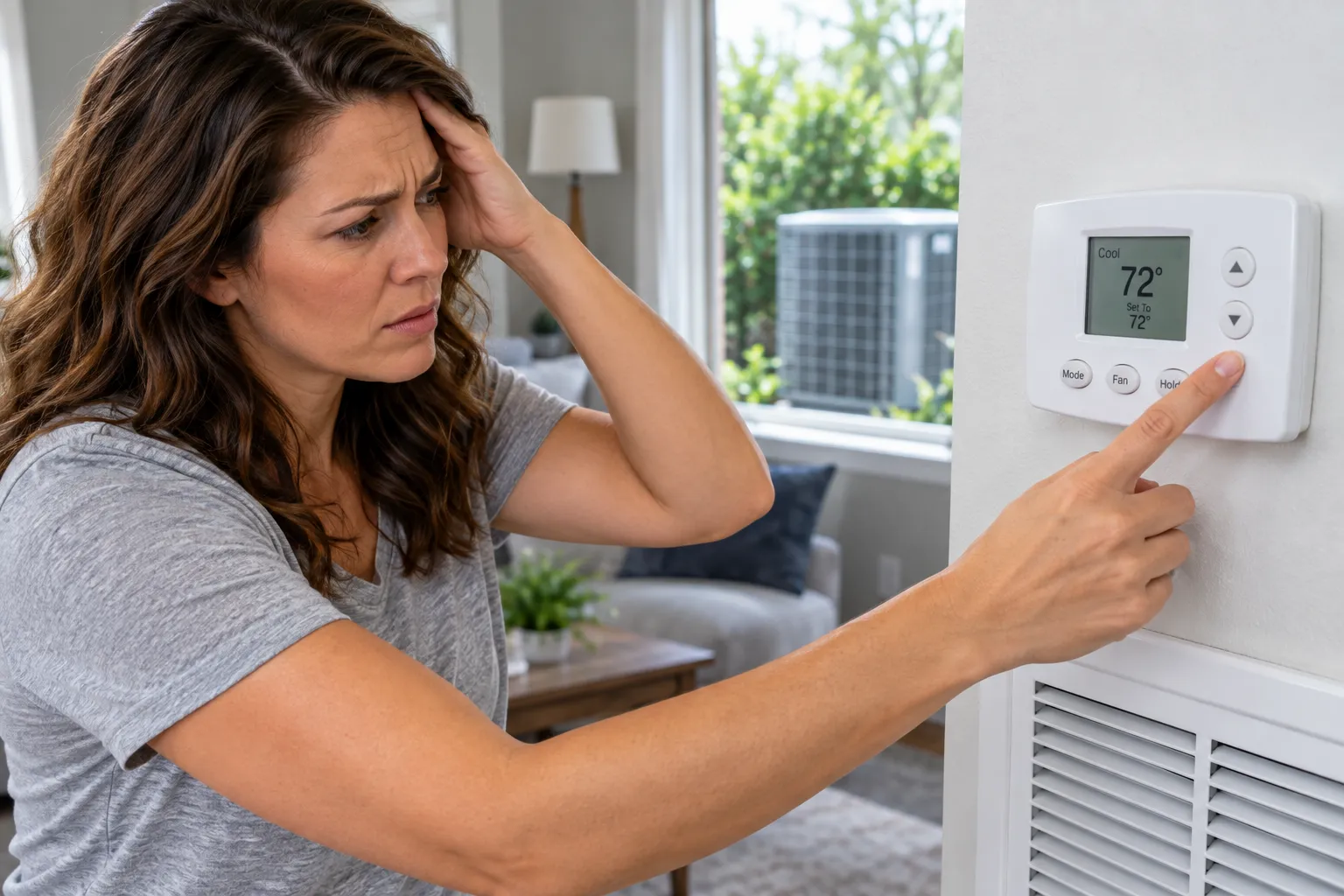
A surprising share of “broken AC” calls are thermostat issues, so start here — it takes a minute:
- Mode must be on Cool, not Heat, Fan-only, or Off. Fan-only circulates room air without cooling it, which feels exactly like a dead AC.
- Setpoint must be below the current room temperature. Give it a few degrees of gap, then wait 5–10 minutes.
- Batteries: if the display is blank or fading, replace them. Programmable thermostats that run on batteries should get fresh ones about once a year.
- Location matters: a thermostat in direct sun or next to a heat source reads wrong. You can’t move it yourself as a quick fix, but knowing this explains rooms that never seem to cool.
If the thermostat checks out, the problem is downstream. If thermostat behavior itself is the mystery — schedules, sensors, wiring — our thermostats hub collects those topics separately.
2. Check the air filter
A clogged filter is the single most common cause of weak cooling. It chokes airflow across the indoor coil, which both reduces cooling and can freeze the coil solid.
- Pull the filter and hold it up to light. If you can’t see light through it, replace it.
- Check filters once a month during cooling season, and change a dirty filter right away — or at least every three months even if it looks borderline. This matches the ENERGY STAR maintenance checklist, which lists monthly filter checks as a homeowner task.
- After replacing a badly clogged filter, give the system 30–60 minutes before judging the result.
3. Check power: breakers and switches
This section assumes the indoor fan runs. If nothing runs at all — no fan, no outdoor hum — skip to our won’t-turn-on guide instead.
Your system has more than one power path, and any of them can interrupt cooling while the indoor fan keeps running:
- Look for a tripped breaker labeled AC, air handler, or condenser. If it’s tripped, reset it once. If it trips again immediately, leave it off — that repeat trip is the system telling you something is wrong, and it needs an electrician.
- Check the outdoor disconnect switch (a small box near the condenser) — landscapers and kids flip these more often than you’d think.
- Check the furnace/air-handler switch, which often looks like a regular light switch on or near the indoor unit. During heating season someone may have turned it off.
4. Check airflow at the vents
Walk the house and feel every supply vent while the system runs:
- Vents blocked by furniture, rugs, or closed dampers starve rooms of cool air. Open them all for this test — closing vents in unused rooms rarely helps and can unbalance the system.
- Weak airflow everywhere points back to the filter, the blower, or duct restrictions.
- Strong airflow in some rooms but not others points to duct or damper issues in those runs — note which rooms, since a technician will ask.
5. Look at the outdoor unit
The condenser needs to dump heat outside. If it can’t breathe, cooling collapses:
- Clear leaves, grass clippings, weeds, and stored items from around the unit so air circulates freely.
- Gently rinse obvious dirt off the exterior fins with a garden hose from the outside (never a pressure washer — bent fins block airflow).
- Listen: the outdoor fan should be spinning while the system calls for cooling. If the fan is still but you hear humming, turn the system off at the thermostat and call a technician — don’t keep running it.
6. Is the indoor coil frozen?
Ice on the copper lines or the indoor coil is a classic “runs but won’t cool” signature. It usually starts with restricted airflow (see step 2) or, less commonly, low refrigerant.
- Signs: visible frost on refrigerant lines, water pooling under the indoor unit as ice melts, or airflow that starts okay and fades to nothing over an hour or two.
- What to do: turn cooling off but leave the fan on so room air thaws the coil — this takes several hours. Replace the filter in the meantime.
- What not to do: don’t scrape ice off, and don’t keep running the system frozen — liquid refrigerant reaching the compressor can destroy it.
- If ice returns after a fresh filter and a full thaw, the likely cause is a refrigerant issue, which belongs to a technician (see below). For the complete thaw procedure and what recurring ice means, see our guide to a frozen or iced-over AC.
Telling common causes apart
| What you observe | Most likely cause | Who fixes it |
|---|---|---|
| Fan-only feel, thermostat on wrong mode | Thermostat setting | You, in a minute |
| Weak airflow everywhere, filter dark | Clogged filter | You, with a new filter |
| Nothing runs after a storm or outage | Tripped breaker or off switch | You, one reset — then an electrician if it repeats |
| Some rooms cool, some don’t | Blocked vents or duct issue | You for vents; a pro for ducts |
| Ice on lines, airflow fades over time | Frozen coil | You thaw it; a pro finds the cause if it returns |
| Humming outdoor unit, fan still | Failed fan motor or capacitor | Technician only |
| Oily residue on lines, chronic undercooling | Refrigerant leak | Technician only |
| Starts and stops every few minutes | Short cycling — a different pattern, see our short-cycling guide | You check filter and thermostat; a pro for the rest |
When to stop and call a technician
Stop DIY diagnosis and call a licensed HVAC technician if you hit any of these:
- Ice that returns after a thaw and a clean filter — the system likely needs refrigerant work.
- Burning smells, scorch marks, or buzzing from electrical components.
- A breaker that trips twice — never keep resetting it.
- Anything involving capacitors, contactors, wiring, or sealed refrigerant lines. Capacitors store a dangerous charge, and refrigerant handling is legally restricted: under EPA Section 608, intentionally venting refrigerant is prohibited and servicing it requires certified technicians (EPA Section 608 overview).
- No cooling after all six checks. You’ve ruled out the homeowner-fixable layer; further guessing wastes a hot afternoon. Tell the technician exactly what you checked — it shortens (and cheapens) the visit.
Frequently asked questions
Should I just add refrigerant myself? No. Home AC systems are sealed — low refrigerant means there’s a leak, and finding and fixing it plus recharging to manufacturer specification is contractor work. Venting refrigerant yourself is prohibited under EPA rules.
How often should I really change the filter? Check it monthly while the AC runs daily; change it when dirty, or at least every three months. Homes with pets or construction dust need it more often.
The AC cools fine at night but not in the afternoon — is that normal? Partly: extreme heat is the hardest load. But if the gap is large, suspect the same culprits — dirty filter, weak airflow, or low charge — because a healthy system should still hold temperature on design days. If it can’t, get it checked before the next heat wave.
Sources
- ENERGY STAR, Maintenance Checklist — filter, thermostat, condensate drain, coil, and refrigerant-charge guidance (accessed 2026-09-07).
- U.S. EPA, Stationary Refrigeration and Air Conditioning (Section 608) — venting prohibition and technician certification requirements (accessed 2026-09-07).
- Your equipment’s own manual remains the authority for model-specific filter sizes, locations, and maintenance intervals.
Still stuck after the thermostat, filter, and power checks? The rest of our air-conditioning hub covers each subsystem in more depth as new guides publish.