
Air Conditioning
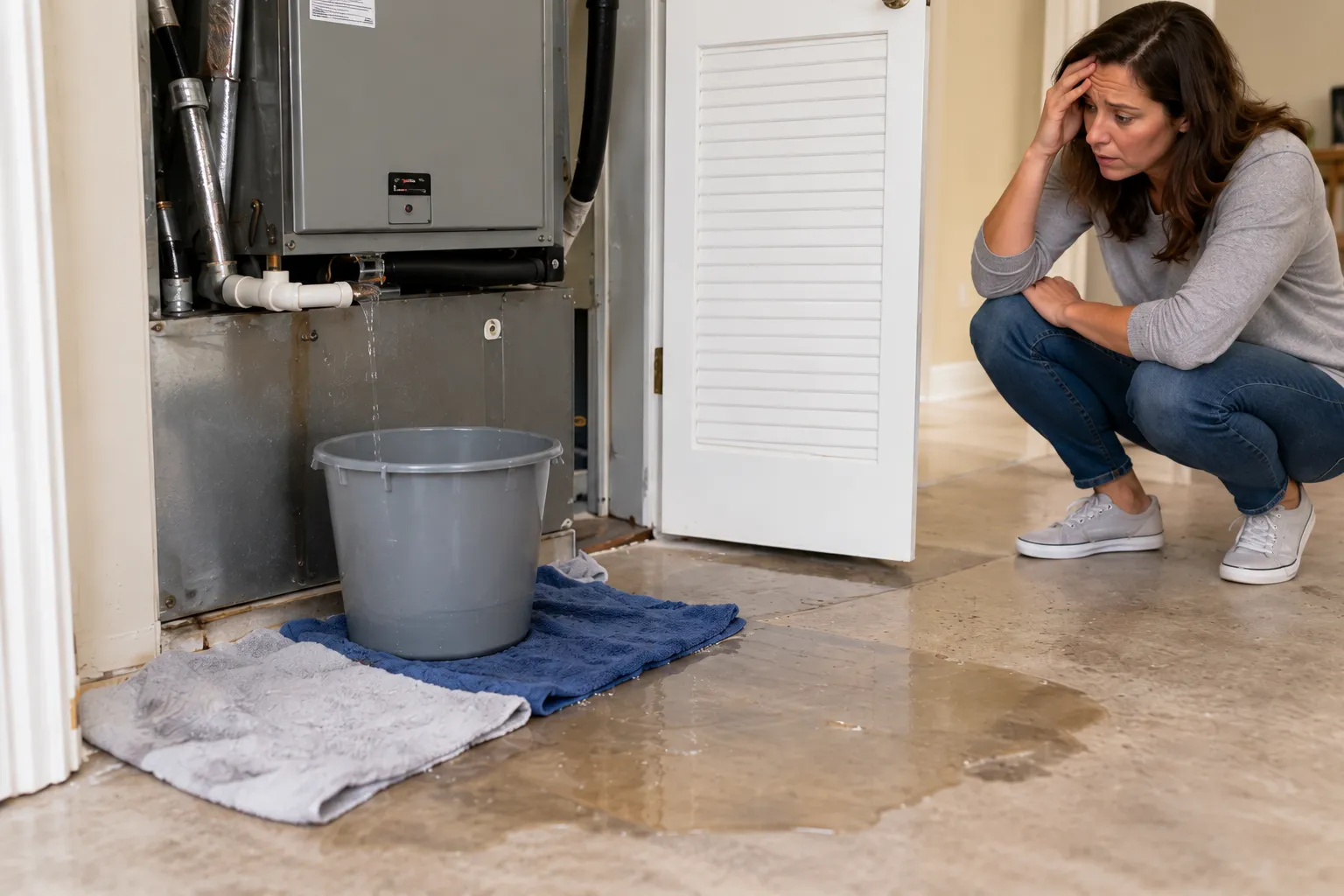
AC Leaking Water Inside? Find the Source Safely
Water dripping from your indoor AC? Learn to tell condensate from other leaks, run safe checks in order, and know when water means calling a technician.
The short answer
Water around your indoor AC unit is almost always condensate the system couldn’t drain — most often a clogged drain line, sometimes meltwater from a frozen coil, occasionally a cracked pan or failed pump. First make sure the water is actually from the AC (it appears while cooling runs, under or near the air handler). Keep water away from anything electrical, turn cooling off if water is spreading or near wiring, then check the filter, look for ice, and inspect the accessible drain exit outside. Persistent leaks, ceiling damage, or water near electrics mean calling a technician.
- Symptom
- Water dripping or pooling around the indoor AC unit while cooling runs
- Likely cause
- Clogged condensate drain line, frozen-coil meltwater, cracked pan, or failed condensate pump
- Safe check
- Confirm AC source, power state, filter, visible ice, outdoor drain exit, water near electrics
- Next step
- Call a technician for active overflow, ceiling damage, electrical contact, recurrence, or visible mold
Is it really the AC?
Before troubleshooting the air conditioner, confirm the water belongs to it:
- Timing: AC condensate appears while cooling runs and for a while after it stops. Water that’s there regardless of cooling, or that arrived with rain, points to roof, plumbing, or groundwater instead.
- Location: condensate shows up under or beside the indoor air handler, furnace closet, or attic unit — following gravity from the equipment. Stains far from any equipment are rarely AC water.
- Look: condensate is clear and odorless. Oily residue suggests refrigerant oil (technician-only, never touch), and colored or smelly water suggests a plumbing or sewer issue, not the AC.
If it’s not the AC, this guide stops here — call the right trade for the actual source.
Where the water is tells you the cause
| What you see | Most likely cause | Your move |
|---|---|---|
| Steady drip from the indoor unit while running | Clogged drain line | Check the outdoor drain exit; clear accessible blockage |
| Sudden puddle after weak cooling, ice was visible | Frozen-coil meltwater | Switch to our frozen-coil guide |
| Water in the emergency/overflow pan | Primary drain failed, backup catching it | The backup bought you time — clear the primary or call a pro |
| System dead plus standing water | Float switch shutdown | See won’t-turn-on if it won’t restart after draining |
| Stained, sagging ceiling under an attic unit | Long-term overflow | Stop using cooling, call a technician — structural damage risk |
Safe homeowner checks, in order
- Stop the water first. If it’s actively spreading or near anything electrical, turn cooling off at the thermostat. Use towels and a bucket to contain what’s there — standing water damages floors and feeds mold within a day or two.
- Check the filter. A badly clogged filter freezes coils, and the resulting meltwater overwhelms drains. Replace it if dirty.
- Look for ice. Frost on refrigerant lines means you’re dealing with a freeze-thaw cycle, not a simple clog — follow the frozen-coil thaw procedure instead of forcing the drain.
- Inspect the outdoor drain exit. Find where the condensate line terminates outside (usually a small PVC pipe near the condenser). Clear leaves, mulch, or visible blockage from the opening with your hands. That’s the full extent of homeowner drain work.
- Assess electrics from outside. If water reached the furnace cabinet, outlets, or wiring — or you smell burning — leave the breaker off and call a professional. Do not energize wet equipment to “test” it.
Common causes, in practical order
- Clogged condensate drain line — dust, algae, and sludge narrow the line until it backs up. The ENERGY STAR maintenance checklist lists drain inspection precisely because plugged drains cause water damage. Clearing deep clogs (vacuums, snakes, disassembly) is technician work; your scope ends at the accessible exit.
- Frozen coil meltwater — ice built up silently, then melted all at once. If you saw frost, treat the freeze first (frozen-coil guide); the drain may be perfectly fine.
- Cracked or rusted drain pan — older metal pans corrode through. Replacement means opening the unit: technician job.
- Failed condensate pump — basement and attic systems often pump water uphill. A dead pump overflows fast; pump electrical repair is pro-only.
- Disconnected or mis-sloped line — recent work around the unit can knock a line loose. Reconnecting an accessible slip joint you can fully see is reasonable; anything inside the cabinet is not.
When to shut down and call a professional
- Water touching wiring, the furnace, outlets, or the breaker area.
- Any burning smell, buzzing, or a breaker that trips more than once.
- Stained or sagging ceilings — water has been traveling inside structures.
- Overflow that returns after you cleared the accessible exit.
- Visible mold around the unit or vents — remediation is its own specialty; don’t run a mold-suspect system and don’t spray biocides into ducts yourself.
- Recurring freeze-thaw cycles behind the water (frozen-coil recurrence explains why that needs a pro).
Frequently asked questions
Can I keep running the AC while it leaks a little? No. “A little” becomes ceiling damage quickly, and water migrates toward electrics. Turn cooling off until you know the source and the drain flows.
Should I pour bleach or vinegar down the drain line? Don’t pour chemicals into a line you can’t see through. Clearing visible debris from the outdoor exit is safe; chemical or pressure clearing inside the system belongs to whoever services it — ask your technician what prevention they recommend for your setup.
The leaking stopped on its own — am I fine? Not necessarily. Intermittent leaks (freeze-thaw, partial clogs, pump working sometimes) pause and return worse. If you never found the cause, have it checked before the next heat wave.
Sources
- ENERGY STAR, Maintenance Checklist — condensate drain inspection and water-damage risk (accessed 2026-09-07).
- U.S. EPA, A Brief Guide to Mold, Moisture and Your Home — fix water problems promptly; do not run systems that may spread contamination (accessed 2026-09-07).
- Your equipment’s manual for drain-pan layout, float-switch location, and filter sizes.
If the system runs steadily but simply doesn’t cool, see our no-cooling walkthrough. For the full system view, browse the air-conditioning hub.