
Air Conditioning
AC Frozen or Iced Over? How to Thaw It Safely
Ice on your AC lines or coil? Learn why air conditioners freeze, how to thaw the system safely step by step, and when recurring ice means calling a technician.
The short answer
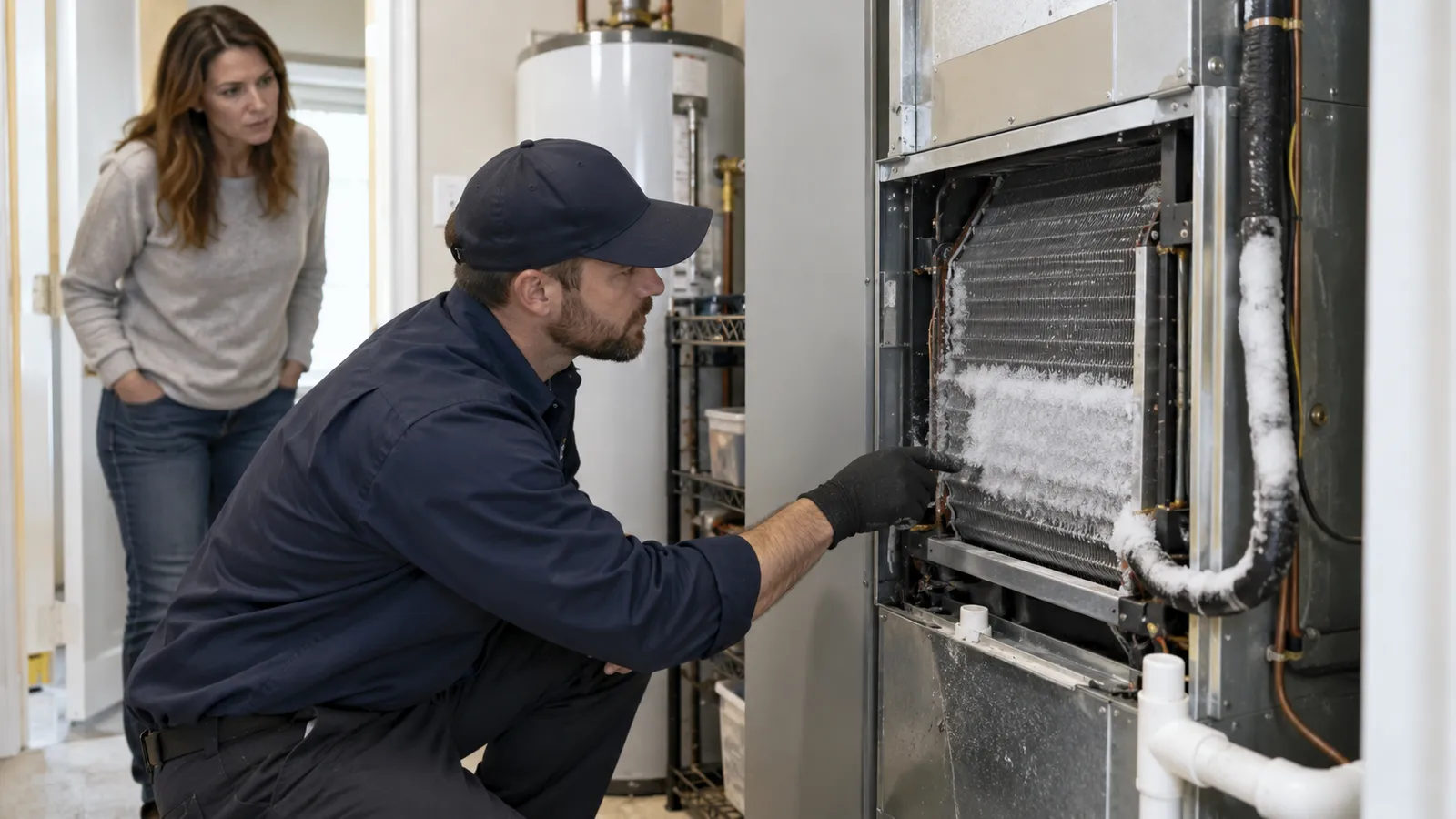
If you see ice or frost on your air conditioner’s refrigerant lines or indoor coil, turn cooling off but leave the fan on, and let the ice thaw completely — this takes several hours. Replace the air filter while you wait and open any closed vents. Then restart and watch: if ice comes back, the root cause needs a technician. Never scrape ice off, never keep running a frozen system, and never open sealed refrigerant lines yourself.
- Symptom
- Visible ice or frost on AC refrigerant lines, indoor coil, or outdoor unit
- Likely cause
- Restricted airflow from a dirty filter or blocked vents; less commonly low refrigerant or blower problems
- Safe check
- Power down cooling, thaw fully, replace filter, open vents, restart and observe
- Next step
- Call a technician if ice returns, if you suspect a leak, or if water reaches electrical parts
Why air conditioners freeze
Freezing is almost always an airflow problem or a refrigerant problem — sometimes both feeding each other:
- Restricted airflow (most common). A clogged filter, closed vents, or a dirty blower slows air across the indoor coil. The coil gets too cold, condensation on it freezes, and the ice further blocks airflow — a loop that builds until cooling stops. This is the same mechanism behind the filter guidance in the ENERGY STAR maintenance checklist, which lists monthly filter checks as a homeowner task.
- Low refrigerant. A system low on charge runs its coil colder than designed. Because home systems are sealed, low charge means a leak somewhere — not normal consumption. Checking and adjusting charge to manufacturer specification is contractor work, and handling refrigerant requires certified technicians under EPA Section 608.
- Blower or control problems. If the indoor blower doesn’t move enough air — failed motor, bad capacitor, control fault — the coil freezes even with a clean filter. These are technician diagnoses, not homeowner repairs.
- Running cooling in cool weather. Running the AC when it’s chilly outside can freeze a coil on systems without low-ambient controls. Check your manual for the minimum outdoor temperature for cooling mode.
Notice what this means for triage: the homeowner-fixable layer (filter, vents, thaw, observe) comes first, and everything sealed, charged, or wired belongs to a pro.
Step 1: Turn cooling off, keep the fan on
At the thermostat, switch the mode from Cool to Off, then set the fan to On (not Auto). Room-temperature air moving across the coil thaws it far faster than letting it sit. If the thermostat is unresponsive or the system keeps running, turn the system off at the breaker — once — and leave the fan running only if you can do so safely from the thermostat.
Step 2: Let it thaw completely
This is the step people rush, and rushing it causes repeat freeze-ups:
- Expect several hours for a fully iced coil — often 3–6 hours for heavy buildup, sometimes longer. Partial thaws refreeze quickly.
- Put towels around the indoor unit and check the condensate drain area. Thawing releases a lot of water at once, and a plugged drain can overflow — ENERGY STAR specifically flags drain inspection because backups cause water damage.
- Don’t scrape, chip, or pour hot water on ice. Mechanical force damages delicate coil fins, and sudden heat stresses the metal.
Step 3: Check the filter and vents while you wait
Use the thaw time productively:
- Replace a dirty filter — hold it to light; no light means no airflow. This single step resolves most first-time freeze-ups.
- Open every supply vent and confirm returns aren’t blocked by furniture or rugs.
- Look (don’t touch) at the outdoor unit for heavy debris matting the fins.
Step 4: Restart and watch
Once all visible ice is gone and the area is dry, restore cooling and observe for a full cycle:
- If cooling returns and stays normal for 24 hours, the freeze was almost certainly airflow-related, and you’ve fixed it. Keep the monthly filter habit.
- If water keeps dripping with no ice left anywhere, that’s a drainage problem rather than a freeze problem — see our leaking-water guide.
- If airflow starts strong and fades again, or frost reappears on the lines, stop there — you’ve confirmed a deeper cause (likely charge or blower) that needs instruments you don’t have.
If ice keeps coming back
Recurring ice after a full thaw and a clean filter is the system telling you the root cause is sealed or wired:
- A technician will measure refrigerant charge against manufacturer specification, search for leaks, and verify blower performance — the same contractor-side items ENERGY STAR lists for professional check-ups.
- Tell them exactly what you did (thaw time, filter condition, how fast ice returned). That history shortens the diagnosis.
- Don’t agree to repeated “top-offs” without a leak search: refrigerant doesn’t get used up, so a system that needs charge twice has a leak.
When to call a technician right away
- Burning smells, buzzing, or scorch marks anywhere near the equipment.
- Water pooling around electrical compartments or the breaker panel.
- A breaker that trips more than once.
- Oily residue on refrigerant lines (a classic leak sign) or hissing sounds.
- Any urge to open panels, test capacitors, or touch refrigerant lines — all technician-only by law and by physics.
Frequently asked questions
Can I use a hair dryer or hot water to speed up thawing? Don’t. Focused heat warps thin coil fins and thermal shock can crack joints. Room-temperature airflow from the fan is slower but safe — patience is the actual fix here.
My AC cools fine but there’s a little frost on one line — is that urgent? Light, transient frost that melts on its own can happen on humid days, but persistent frost is never normal. Treat it as an early warning: check the filter now rather than waiting for a full freeze.
No ice at all, just warm air — is this the wrong guide? Yes — start instead with our no-cooling walkthrough, which covers thermostat, power, and airflow checks in order and links back here only if you find ice.
Sources
- ENERGY STAR, Maintenance Checklist — filter, drain, coil, and refrigerant-charge maintenance roles (accessed 2026-09-07).
- U.S. EPA, Stationary Refrigeration and Air Conditioning (Section 608) — venting prohibition and technician certification (accessed 2026-09-07).
- Your equipment’s manual for model-specific filter sizes, minimum cooling temperatures, and drain locations.
For the broader cooling-problem diagnosis this guide plugs into, see our air-conditioning hub.