
Air Conditioning
AC Smells Musty When It Turns On? What to Check
Musty or damp odor from your AC vents? Learn to tell musty from burning or chemical smells, trace the likely source, and know when odor means calling a pro.
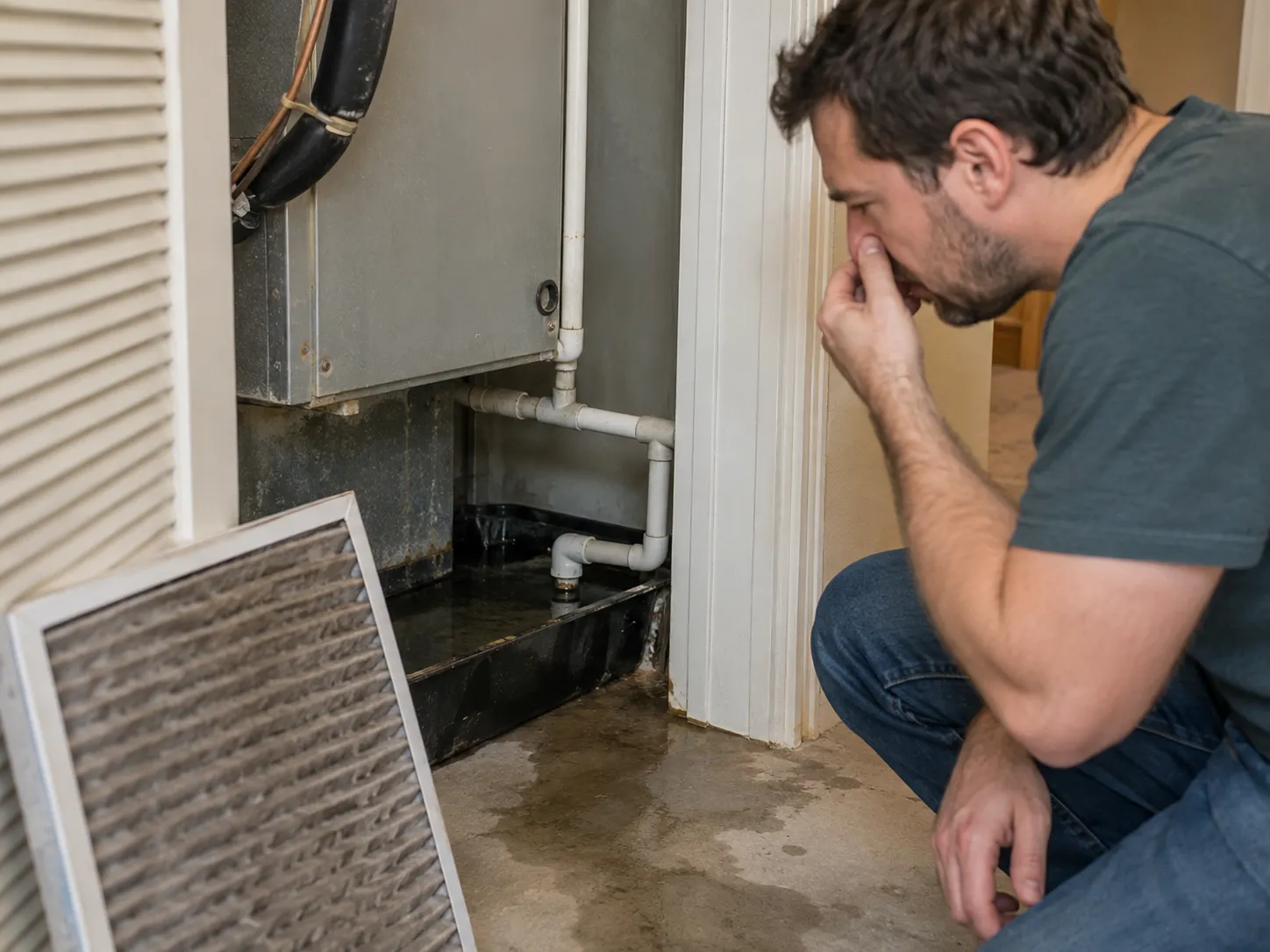
The short answer
A musty or damp smell in the first minutes after your AC starts usually points to moisture sitting where it shouldn’t — most often a dirty filter, a condensate drain area staying wet, or buildup on damp surfaces inside the system. Check the filter, look for visible standing water around the indoor unit, and note when the smell appears. What you must not do: open panels or ducts, spray bleach, biocides, or deodorizers into the system, or keep running an AC that smells like burning. Musty and burning are different problems with opposite urgency — this guide covers musty; burning means turning the system off and calling a professional immediately.
- Symptom
- Musty or damp odor from vents, strongest in the first minutes after AC starts
- Likely cause
- Dirty filter, wet condensate drain area, damp coil surfaces, or duct moisture
- Safe check
- Smell triage, filter condition, visible standing water, humidity context
- Next step
- Call a professional for visible mold in ducts or coil areas, persistent odor, or any burning smell
First: which smell is it?
Odor triage decides everything, so be precise before touching anything:
- Musty, damp, locker-room, or “dirty socks” — microbial growth on something staying wet: filter, drain pan area, coil surfaces, or ducts. This guide.
- Burning, melting-plastic, hot-electrical, or smoke — stop. Turn the system off and call an electrician or HVAC professional. Do not run it to confirm, do not open panels to look. This is not a troubleshooting exercise.
- Sweet-chemical, paint-like, or rotten-egg — not covered here either. Sweet-chemical odors near AC equipment can relate to refrigerant oil or other chemicals: don’t investigate closely, ventilate the area, and call a professional. Sewer-like odors usually come from plumbing, not the AC.
If you’re unsure between musty and burning, treat it as burning until proven otherwise.
Safe homeowner checks, in order
- Note the timing. Musty-only-at-startup that fades points to moisture sitting in the system between cycles. A smell that never fades, or worsens while running, points to an active moisture source — take it more seriously.
- Check the filter. A clogged, damp filter is the most common musty source and the easiest fix. Replace it if dirty — hold it to light; no light means no airflow.
- Look for visible standing water. Check around the indoor unit and the accessible condensate drain exit outside. Standing water plus musty smell means the drain area needs professional attention; clear only visible debris from the outdoor exit with your hands.
- Check humidity context. Sticky indoor air plus musty odor suggests moisture isn’t being removed properly. Note thermostat fan setting (constant fan recirculates moisture), recent weather, and whether bathrooms or kitchens vent properly — all observation, no equipment changes.
- Look, don’t open. If you can see mold growth on accessible surfaces near vents or the unit exterior, stop and call a professional. Never open the air handler, ducts, or coil compartments to hunt for mold, and never spray bleach, biocides, ozone, or deodorizers into the system yourself.
Likely sources, in practical order
- Dirty or damp filter — traps organic matter that goes musty. Resolved with a replacement.
- Wet condensate drain area — a slow or partially blocked drain keeps the pan area damp between cycles. Accessible-exit check only; deeper clearing is technician work.
- Damp coil and cabinet surfaces — normal condensation that never fully dries between short cycles. Improved filter habits and correct fan settings help; coil cleaning inside the unit is pro work.
- Duct moisture or buildup — musty smell from many or all vents with no visible water at the unit suggests duct involvement. Duct interiors are never a homeowner workspace: no opening, no fogging, no bleach.
- Oversized short-cycling system — a system satisfying the thermostat too fast never runs long enough to dehumidify, leaving everything clammy. Only a professional load calculation can confirm sizing; never assert it without one.
When to stop and call a professional
- Any burning, melting-plastic, or electrical smell — system off, professional now.
- Visible mold growth in or around ducts, coil areas, or the unit interior.
- Musty odor that persists after a fresh filter and a dry drain exit.
- Standing water you can’t trace to an accessible cause, or water near anything electrical.
- Health symptoms that track with AC use — discuss with both a professional and, as appropriate, a medical one; we diagnose equipment here, not people.
- Recurring moisture despite clean filters — the root cause (charge, airflow design, drainage slope) needs instruments and access you don’t have.
Frequently asked questions
What is “dirty sock syndrome”? A nickname for a musty odor that appears when the system starts, commonly associated with bacterial buildup on damp coil surfaces. The name describes the smell, not a diagnosis — work through the checks above rather than assuming the cause.
Will changing the filter fix a musty smell? Often, when the filter itself is the source. If a fresh filter plus a dry drain area doesn’t clear the odor within a day or two of normal running, the source is deeper (coil, pan, or ducts) and needs a professional.
Can I pour bleach or vinegar down the drain line to kill the smell? Don’t pour chemicals into a system you can’t see through. Clearing visible debris from the outdoor drain exit is the safe scope; chemical or pressure clearing inside the system belongs to whoever services it — ask your technician what prevention they recommend.
Sources
- U.S. EPA, A Brief Guide to Mold, Moisture and Your Home — fix water problems promptly; keep drip pans clean and drain lines unobstructed; do not run systems that may spread contamination (accessed 2026-09-07).
- U.S. EPA, Should You Have Your Air Ducts Cleaned — duct cleaning never as routine prevention; consider it with visible mold, vermin, or excessive debris (accessed 2026-09-07).
- ENERGY STAR, Maintenance Checklist — filter and drain maintenance roles (accessed 2026-09-07).
- Your equipment’s manual for filter sizes, drain-pan layout, and maintenance intervals.
If you also see water pooling with no ice, see our leaking-water guide. If cooling itself is weak, see our no-cooling walkthrough. For the full system view, browse the air-conditioning hub.