
Humidity
House Air Too Dry? Fixing Winter Dry-Air Symptoms Safely
Static shocks, dry skin, and bloody noses every winter? Learn how to confirm low indoor humidity, raise it safely, and recognize the condensation line that means you've gone too far.
The short answer
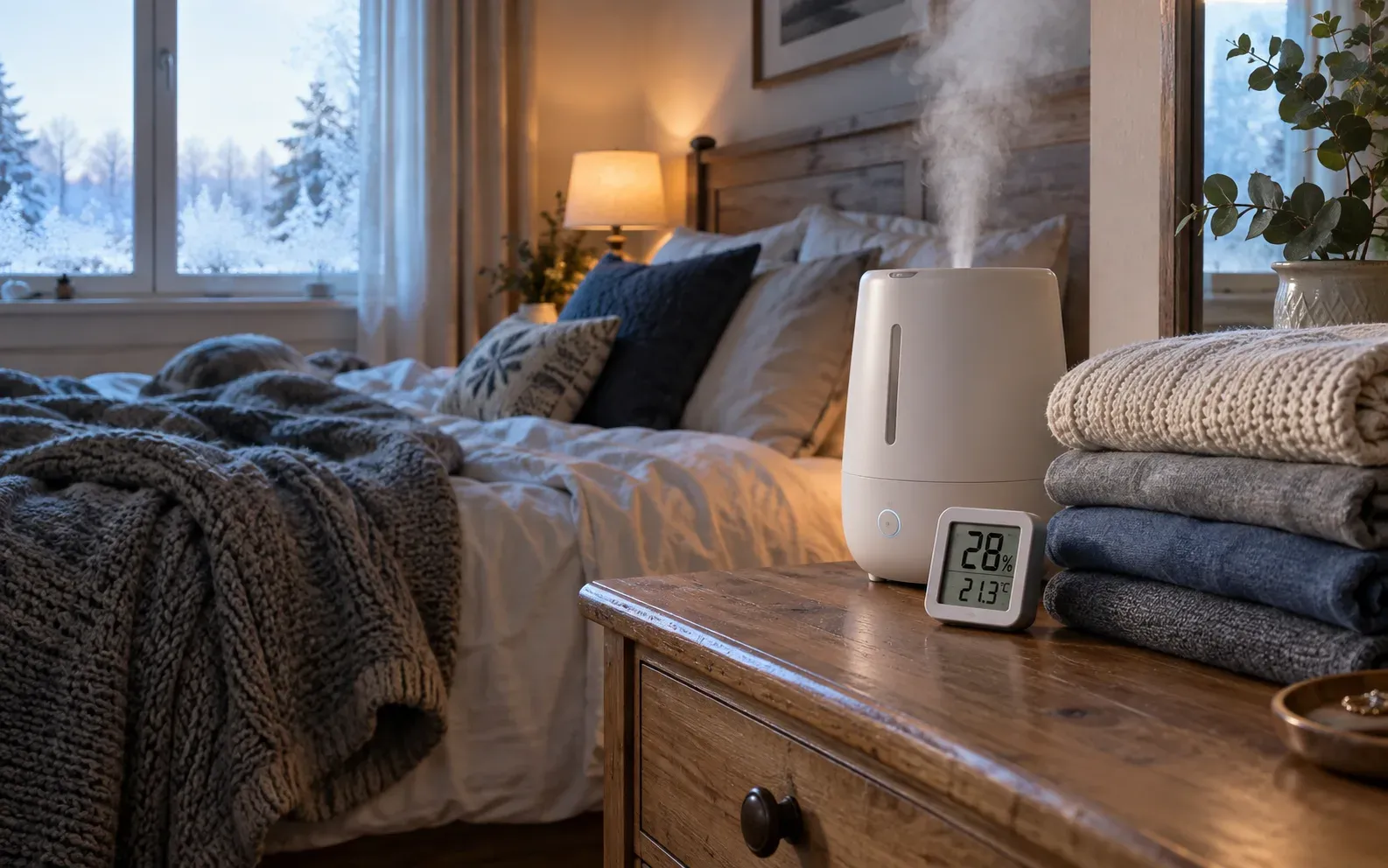
If every winter brings static shocks, dry skin, scratchy throats, and nosebleeds, the likely cause is indoor air dried out by cold weather and heating. Confirm it with an inexpensive hygrometer: NDSU Extension recommends 30 to 40 percent relative humidity in winter — persistently below 30 percent explains the symptoms, and the fix is adding moisture carefully (a clean portable humidifier, shorter showers with the fan off sooner, indoor drying) while watching the windows. Condensation on the glass means you’ve overshot: back the humidifier down.
- Symptom
- Static shocks, dry skin, dry nose and throat, nosebleeds every heating season
- Likely cause
- Cold outdoor air warmed indoors holds little moisture; heating, air leaks, and long exhaust-fan runs dry it further
- Safe check
- Room-to-room hygrometer readings, humidifier setting and cleanliness, exhaust-fan habits, window check for condensation
- Next step
- See a clinician for frequent or heavy nosebleeds; call an HVAC technician for furnace-mounted humidifier problems
Is the air actually dry? Measure first
Winter symptoms overlap with colds, allergies, and simply an overheated house, so measure before buying anything:
- Place a hygrometer in a bedroom or living room, away from humidifiers, bathrooms, and direct heat. Note the reading morning and evening for a day or two.
- Below 30 percent most of the time confirms dry air as the driver. Between 30 and 40 percent in winter is the target band — inside it, look to other causes (illness, allergens, overheating) for lingering symptoms.
- Compare rooms. One dry bedroom with the door shut and the vent blasting differs from a whole house sitting at 22 percent — the first is airflow and habits, the second needs a real moisture strategy.
- Trust a calibrated meter over your skin: NDSU Extension notes that cheap mechanical hygrometers can read more than 20 points off. Verify yours with the salt test (sealed bag, half cup of water with quarter cup of salt, 12 hours — it should read about 75 percent) before acting on the number.
The mirror-image problem: if the air feels sticky rather than papery, windows sweat, or there’s an earthy smell, you’re on the wrong page — work through our humid-house guide instead.
Why heated winter air dries out
Cold outdoor air holds little moisture to begin with; warming it indoors drops its relative humidity further without adding a single drop. Heating systems, air leaking in through gaps, and bathroom fans left running long after showers all push it lower. Tight modern homes hold moisture better; older, leakier houses can sit in the low twenties all winter. None of this means your heating is broken — it’s physics, and the correction is measured humidification, not a new furnace.
Likely contributors, in practical order
Most probable and easiest to verify first:
- Cold, leaky air exchange. The dominant cause in most houses — every cubic foot of cold air warmed indoors needs moisture added. Drafty rooms read driest.
- Exhaust fans running too long. Bathroom fans and range hoods expel warm moist air by design. Running them for an hour after a shower in January trades one problem for another.
- No humidification at all. Many homes simply add zero moisture back. A portable unit in the bedroom often resolves symptoms without touching the whole house.
- A furnace humidifier that’s off, clogged, or mis-set. If you have one and the house is still dry, check its humidistat setting and whether it ran this season — then hand anything beyond the setting to a technician.
- Overheated rooms. Thermostats set high dry the air further and parch skin directly. Dropping a degree or two and adding moisture beats cranking heat against dryness.
Safe homeowner fixes, in order
Work through these and re-measure after a few days at each step. Stop when readings sit in the 30–40 percent band and symptoms ease.
1. Right-size your exhaust habits
- Run the bathroom fan during showers, then switch it off once the mirror clears — not an hour later.
- Use the range hood for actual cooking steam, then off. In winter, every extra fan-hour is moisture thrown outside.
2. Add moisture where you sleep
- Run a portable humidifier in the bedroom on a low or medium setting. Bedrooms matter most because you spend eight hours breathing that air.
- Place it on a hard, level surface away from walls, curtains, and electronics; aim mist into open room air, never at the window.
- Empty the tank daily, rinse it, and clean and dry the unit exactly as its manual says — a neglected humidifier grows mold and bacteria and mists them into the room. If it smells musty despite cleaning, replace the filter or wick, or retire the unit.
3. Reclaim everyday moisture
- Dry a load of laundry on a rack in a living area occasionally (vented dryer the rest of the time), and let shower steam linger by leaving the bathroom door open after the fan finishes.
- Simmering a pot and houseplants add a little; neither replaces a humidifier, but both help at the margin.
4. Check the furnace humidifier setting — setting only
- If your furnace has a mounted humidifier, confirm the humidistat isn’t set to summer-off or near zero, and note whether water reaches it. Anything involving panels, pads, water lines, or drain hoses belongs to the annual HVAC visit — mention it there rather than opening anything yourself.
- Change the furnace filter on schedule; restricted airflow dries unevenly and strains the system (see ENERGY STAR’s homeowner checklist roles for filters).
5. Watch the windows — the stop line
- Check glass each cold morning. A light fog patch that burns off is fine; running droplets, pooling on sills, or frost mean indoor humidity is too high for your windows — turn the humidifier down, not up. If window wetness becomes its own problem, see our window-condensation guide.
- Persistent window wetness despite low settings points at excess moisture elsewhere: hand off to the humid-house guide.
When to stop and call someone
- Frequent, heavy, or one-sided nosebleeds, or any bleeding that won’t stop — that’s a clinician visit, not a humidifier setting.
- A furnace-mounted humidifier that leaks, smells musty, shows mold inside, or hasn’t been serviced in years: call an HVAC technician.
- Symptoms that persist with readings inside the 30–40 percent band — the cause isn’t humidity, and chasing it further wastes the season. Consider allergens, illness, or overheating instead.
- Window condensation you can’t clear by lowering humidity, or any mold beyond a small patch on a hard surface (scrub with detergent and water, dry fully, watch it — spreading growth needs professional remediation).
Frequently asked questions
Will a bowl of water on the radiator fix dry air? Barely. It adds a trickle of moisture to one room while a whole house exchanges air all day. It won’t hurt, but treat it as decoration-level help — a portable humidifier does orders of magnitude more.
Is dry winter air dangerous? Uncomfortable, mostly: dry skin, irritated nasal passages, static, and aggravated eczema. NDSU Extension notes very dry air can irritate airways and raise respiratory susceptibility — reason enough to fix it, not to fear it. The opposite excess (chronic dampness and mold) is the genuinely harmful direction.
Why do I get nosebleeds only in winter? Cold dry air parches nasal membranes until small vessels crack — the classic low-humidity signature, especially overnight in a dry bedroom. A bedroom humidifier plus the 30–40 percent band usually ends it. If bleeds are frequent, heavy, or one-sided, see a clinician regardless of the hygrometer.
Sources
- NDSU Extension, Measure Humidity Level to Avoid Dry Skin, Respiratory Irritations and Excess Moisture — winter 30–40 percent band, below-30 symptoms, hygrometer salt calibration (accessed 2026-09-19).
- U.S. EPA, A Brief Guide to Mold, Moisture and Your Home — moisture-control principles, condensation as high-humidity signal (accessed 2026-09-18).
- ENERGY STAR, Maintenance Checklist — filter and professional check-up roles (accessed 2026-09-19).
- Your humidifier and HVAC manuals for model-specific cleaning, settings, and maintenance intervals.
If the problem turns out to be excess moisture rather than too little, see our humid-house guide. For the full system view, browse the humidity hub.